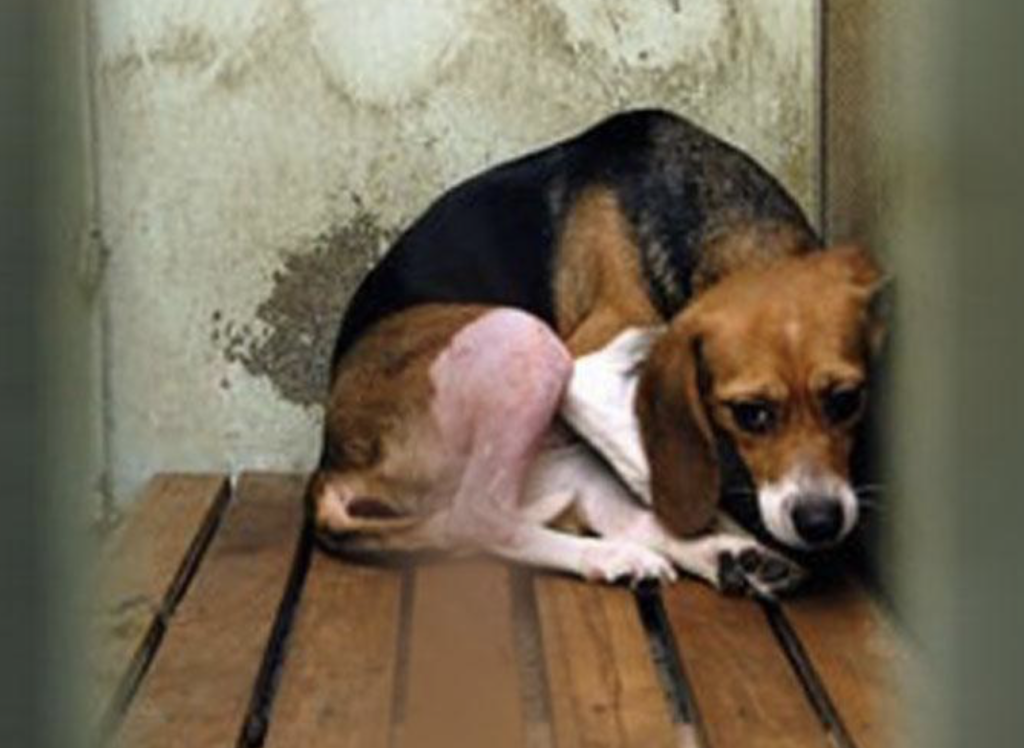
The scared, attention starved dogs wag their tails shyly and are anxious to please but when the dosing begins, their tails stop wagging, they struggle and cry. … Dog number 3216 had a bowel movement immediately after dosing. He salivated and foamed at the mouth. He retched and eventually vomited clear, foamy liquid. He lay down in the back of his cage and stayed there for a long time… Dog number 3220 is very thin. Immediately after dosing, watery yellow diarrhoea squirted uncontrollably from his rectum. He foamed at the mouth and salivated. He wretched and eventually vomited clear foamy liquid just like 3216. We had a lot of trouble dosing dog number 4219. He really fought once the tube was in the back of his mouth. He screamed and yelped and even tried biting at us. We tried holding him in the air, on the ground, and in his cage, but he would not allow the tube to be shoved down his throat. Finally, Irene asked Yimmer to come in and help. We took the dog into an empty room across the hall. Yimmer knew right away which dog was giving us trouble. He said the day before it took ten people to dose that dog. Everyone had to help hold him down so the person dosing could get the tube in. First, Yimmer tried holding him alone while Irene dosed. The dog still fought and screamed. I tried to help hold him and Irene struggled to get the tube near the dog’s mouth. Finally, after several attempts, Irene and I held the dog in the air and Yimmer forced the tube down his throat.
– Diary of Michele Rokke, Undercover investigator at Huntingdon Life Sciences (HLS)
If we witnessed someone forcing weedkiller down a dog’s throat directly in front of us, most of us would intervene – we couldn’t not intervene. We would be horrified and would most likely do whatever was necessary to stop that dog from being poisoned because to look away would be to acquiesce to their abuse. So why is it that as a society, we can so easily ignore what happens to animals when it occurs out of sight? Animals in laboratories can legally be poisoned with toxic chemicals, shot, irradiated, gassed, blown up, drowned, stabbed, burned, starved, restrained to the point where they develop ulcers or heart failure, have their bones broken, limbs amputated, genitals mutilated, be subjected to inescapable electric shocks, sickened with cancers, driven to depression, deprived of sleep to the point of brain damage, infected with diseases, and more. The stuff of our nightmares is the daily reality for animals in laboratories; as long as we do it in the name of scientific discovery, we can become monsters and claim our actions as science. When and why as a society, or as individuals, do we stop caring about what happens to another sentient being? How many razor wire fences must we construct around them before we can ignore their suffering, and can we ever truly be distanced enough that we can shrug our shoulders at their fate?
Animals are not voiceless: They have voices, but we choose not to listen to them. Their cries, squeaks, bellows, yelps and whines are screaming at us to stop torturing them – yet we dismiss them with the argument that animals are somehow lesser beings, their suffering unworthy of our consideration. We seek comfort from our companion animals, all the while ignoring the horrors that we inflict on their brethren. If our dogs were seized from our homes and used for experimentation, there would be righteous outrage and maybe even a revolution. We would not stand for it. We know that animals are individuals who deserve happy lives, lives not cut short by somebody’s curiosity or greed. We are convinced of their ability to think, feel and suffer, and many of us would put our lives on the line to protect them from harm, without hesitation. So why do we allow other dogs and creatures who we do not know to be abused? And for how long will we keep pretending to be blind to their ordeal?
Ten years ago, I was starting a four-year prison sentence in a Young Offender’s Institution for my part in a campaign to close down a notorious contract research facility named Huntingdon Life Sciences (HLS) because I decided to intervene. This is some of that story. It’s embarrassing and deeply personal. I hesitated whether to write this: whether I ought to hide how much I’ve been affected by this experience or whether I ought to speak up about it. It’s difficult for me to vocalise all my feelings about what happened to us as activists and what is still happening to the animals we tried to save. We failed them–and maybe that is the hardest thing to admit. Whatever consequences we faced for our actions, the brutal reality is that the animals we did it all for are still locked up, suffering and dying inside HLS (now rebranded as Envigo and part of Covance). While many activists have struggled to overcome the trauma from the state repression we endured following our actions, HLS has simply rebranded itself, continuing to this day to poison animals for profit–business as usual.
For a very long time, I lost my voice. The words of myself and my fellow activists had been used to jail us. To speak up again and risk further repercussions filled me with dread. Following our convictions, our faces and mugshots were splashed across the front pages of newspapers nationwide. The press focused on my story in particular, not because I’d done more than my co-defendants, but because the press delighted in detailing the downfall of the teenage ‘former A-grade public schoolgirl’ who had been ‘brainwashed’ into joining a ‘cult’. It was an enticing story, an untrue story, but the truth didn’t seem to matter in the tabloid furore. We had been judged as thugs and bullies, and it felt like no matter what I said, no one would listen. So I stayed quiet. Inside, I burned. But I could find no words to express myself, and I was petrified of the consequences of saying what I wanted to say. It’s taken me too long to find the courage, but this is an attempt at finding my voice again: of speaking my truth and of trying to stand up when it would be easier to stay pushed down.
For as long as I can remember I’ve cared about animals. When I was in high school, I printed a quote by Holocaust survivor, Elie Wiesel that I stuck next to the family computer as a reminder to myself: “We must always take sides. Neutrality helps the oppressor, never the victim. Silence encourages the tormentor, never the tormented.” History classes had disturbed me with stories of “good” people who could look the other way during atrocities, and I resolved to be someone who acts whenever possible, who speaks out when it’s hard and who doesn’t remain silent when silence can mean complicity. A few years later, while I was still a teenager, I was arrested and prosecuted because I really thought that if I tried hard enough–if I refused to remain neutral or stay silent in the face of an injustice–I could put an end to some of the most wicked animal abuse that we allow in the name of science. If only people knew what was going on, if only people listened, if only people could be persuaded to change their minds or see things in a different light, things could be different. Things would be different.
I will never forget the first time I found out about HLS, Europe’s largest animal testing laboratory, which has been exposed seven times for animal cruelty and laboratory malpractice. Passionately hating injustice of any kind and with the internet at my fingertips, it was inevitable that I would begin to discover the cruelty of the world that we have hidden away behind locked doors and razor wire. By exposing myself to the violent truth, I washed away any illusion that we live in a just and fair world. I would spend hours each night, watching link after link of animal abuse that was recorded in slaughterhouses, puppy mills, fur farms and yes, laboratories. It never ended. The abuse never stopped. The videos always led to more. The cycle was never-ending. I vividly remember the first time I watched the undercover video footage recorded inside HLS. I remember shaking uncontrollably, how I could not stop the tears from streaming down my cheeks as I heard, for the first time in my life, a dog screaming in pain and fear.
Those videos haunted me. They still do. I can still hear that dog’s screams in my head; I can still see their confused faces behind the bars of their cages, their tails wagging nervously. I couldn’t then, and I cannot now, understand how this abuse is tolerated. Perhaps the worst thing was not the blatant acts of cruelty. No, not the farmer stabbing a downed cow with a pitchfork, the slaughterhouse worker burning a cigarette on a pig’s back or the lab technician repeatedly punching a puppy in the face because he couldn’t find a vein. No, it was the glimpse into the horror that is those animals’ everyday lives that still shadows me. I guess it’s because, if you try hard enough, you can fool yourself into thinking that those acts of violence are one-offs done by horrible people who will hopefully lose their jobs, and that by exposing it, we have stopped it. What you cannot fool yourself into believing is that anything will ever change for the other animals. The victims not of intentional cruelty, but of standard practices: The yelping of a puppy having a tube shoved down her throat and weedkiller poured into her stomach so that she drools, vomits and spasms while she is being poisoned to death; The mother cow bellowing and chasing after the newborn calf being stolen from her so that we can drink her milk; The pig squealing in fear as he tries frantically to escape the stench of blood and death that looms from the kill-line he is being prodded towards. These things aren’t illegal. And that’s what, in my mind, makes it so much worse – because we cannot comfort ourselves by believing that the law will catch up with the perpetrators and the abuses stopped. Our legal system says no crime is being committed: There are no perpetrators. For some reason, these laws that protect us and our companion animals, these moral compasses we profess to live by, do not extend to animals who had the misfortune of being born in the wrong place.
Animals in laboratories and factory farms do not need to fear the brutality of a frustrated employee to live a miserable existence. Their lives are full of neglect, agony and terror every single day they are alive. Yet still our legal systems claim that there is no crime, nothing to concern ourselves with. But, for as long as we deny the crimes we commit against animals, they will never have justice.
It feels odd to be so aware of the wrongs of the world and discover that precious few seem to care. It’s odder still, to find yourself coming up against the law when all you want is for the law to do what it ought to do: protect the innocent. Sadly for animals in laboratories, the law allows for researchers to virtually do as they please to animals and remain immune from prosecution. We know so little about the suffering of animals in laboratories because it is intentionally hidden under a veil of secrecy, reported in scientific papers in language designed to obfuscate—out of sight, out of mind and free from scrutiny.
In 1997, the inherently barbaric nature of animal experimentation shocked the British nation in a documentary that was secretly shot in HLS and aired on Channel 4 called “It’s a Dog’s Life”. The distressing footage showed workers screaming at, shaking and punching puppies repeatedly in the face. In 1998, HLS was again exposed, this time by PETA at the US facility, with an undercover investigator obtaining over 50 hours of footage using a pinpoint camera hidden within her glasses. The footage showed a monkey being dissected while still conscious, and documents within the facility revealed a planned experiment to break the legs of beagles to test an osteoporosis drug. HLS subsequently obtained a gagging order against PETA, preventing the organisation from publicising or talking any further about any of the information they had discovered. This order even prevented them from communicating with the American Department of Agriculture, who had planned to investigate the evidence.
Because the authorities would not help the animals trapped inside Huntingdon Life Sciences, Stop Huntingdon Animal Cruelty (SHAC) was formed in 1999. The organisation had just one goal: to close down the laboratory. Having already successfully closed down two facilities breeding dogs and cats for the vivisection industry, the founding activists knew that protesting outside the laboratory would have little effect. Instead, they decided to launch a leaderless international economic pressure campaign, focusing on the companies who dealt with the lab:
1. The customers (multi-billion dollar agribusinesses and pharmaceutical companies)
2. The suppliers providing services and goods (animal breeders, transporters, cage suppliers, etc.)
3. The financiers (shareholders, high street banks and insurance providers)
The idea was to make it too bothersome to deal with the laboratory, by being as annoying as possible and frustrating the companies enough for them to not want the hassle involved. If the laboratory had no suppliers, customers or financiers, they would not be able to remain open, and we would save the 500 animals who HLS were killing every single day. HLS needed these companies to survive, but the companies did not need the laboratory. To this end, SHAC encouraged members of the public to do everything they could to convince companies to stop dealing with the lab. The SHAC campaign put action at the forefront:
“Words and tears mean nothing to the animals trapped in their cages inside HLS waiting to die. They deserve nothing less than our utmost commitment to take action every day to close down the lab that holds them captive and slowly kills them. Taking action is coming on demonstrations, writing letters, making phone calls, sending emails or faxes, telling other people about the campaign, distributing leaflets, fundraising, putting up posters and stickers. Action is whatever you can do to close down the hell-hole that is Huntingdon Life Sciences”.
From its beginning, SHAC was an innovative campaign encompassing different methods of protest. These methods ranged from national marches, demonstrations and petitions to acts of civil disobedience such as road-blocks, office invasions, conference run-ins, electronic civil disobedience and demonstrations at the homes and on the roof-tops of directors and CEOs. SHAC recognised that the shining glass facades of company premises hid the very real people who were responsible for deciding company policies, and thus they went straight to their homes to demand that they stop dealing with Huntingdon Life Sciences. SHAC didn’t shy away from confrontation, regularly experimenting with and adapting different tactics to achieve its aims. It published data for others to act on, acting as a source of information for a loose network of activists around the globe. Despite an evolving judicial landscape where boundaries between what was lawful and unlawful were constantly shifting, SHAC attempted to remain within the law, hiring barristers to ensure all campaign communications were lawful. On the SHAC website and in every SHAC newsletter, beside a list of publicly available contact details for companies dealing with HLS, a disclaimer urged supporters to keep their communications with companies polite. “Remember that we want these people on our side so make your communication courteous and informative”, read one published disclaimer. “Company details are listed for the purposes of readers making informative and polite communications with the companies listed. The details are not intended for repetitive, rude or threatening calls”, stated another, while a further added, “Remember many staff are sympathetic and may be the ones who told us of their company’s involvement in the first place! Keep your communications polite and informative- taking action is what counts.”
While SHAC led an above-ground movement against the laboratory, the underground Animal Liberation Front (ALF) also took notice of HLS. These activists did not abide by the disclaimers posted by SHAC and instead took illegal non-violent direct action against the listed companies in an effort to force them to sever their ties to the facility.
Any group of people who are vegans and who carry out actions according to the following ALF guidelines have the right to regard themselves as part of the ALF:
• To inflict economic damage on those who profit from the misery and exploitation of animals.
• To liberate animals from places of abuse, i.e. laboratories, factory farms, fur farms etc., and place them in good homes where they may live out their natural lives, free from suffering.
• To reveal the horror and atrocities committed against animals behind locked doors, by performing nonviolent direct actions and liberations
• To take all necessary precautions against harming any animal, human and non-human.
Some activists, keen to target HLS from any and every angle possible would undertake actions under the banner of both SHAC and the ALF, in the daytime, participating in demonstrations and at nighttime, causing economic sabotage or liberating animals from linked facilities. While other campaigns often distanced themselves from the ALF, SHAC acknowledged taking direct action as an essential part of the struggle for liberation, recognising that throughout history, the most successful movements have usually involved both legal and illegal forms of protest. SHAC advocated prisoner solidarity and encouraged prisoner support for those who had been jailed for crimes relating to animal liberation, while simultaneously emphasising that the SHAC organisation itself was not involved in any criminality and operated purely on a legal basis against HLS.
The SHAC campaign was remarkably effective. “No group is more dangerous or determined to end animal testing than the Europe-based Stop Huntingdon Animal Cruelty” warned the Journal of Life Sciences. The Financial Times described the effect of the grassroots movement: “A small group of people have succeeded where Karl Marx, the Red Brigade and the Baader-Meinhof Gang all failed.” It was no longer just an animal rights campaign – it was rooted in a fight against big business, industry and capitalism itself.
Over 250 companies cut ties to the laboratory including Citibank, the world’s largest financial institution; Marsh, the world’s largest insurance broker and HSBC, the world’s largest bank. It wasn’t a change of heart that had convinced them, but rather a focused effort by campaigners that made the companies issue statements committing to have no further dealings with the laboratory. Josh Harper, imprisoned in the USA under the Animal Enterprise Terrorism Act for his role in the campaign explained: “We were the barbarians at the gate, an alliance of the kind of people who did not usually get heard by the mega-rich of the world. Tooth and nail we went after their profits, and along the way refused to divide and fracture over broken windows or graffiti. Everyone was welcome if they would fight.” While animals were continuing to suffer inside HLS, activists made sure that they could not be forgotten, blocking phone lines, email-spamming companies, sending black faxes and staging office occupations. They also took the campaign to the doorsteps of the CEOs of major corporations, demanding the decision-makers take action by protesting at their homes, their summer homes, their golf clubs, their yacht clubs and at their society functions, and even their ballets. If you were profiting from a contract with HLS, a loose band of people were determined not let you forget about it.
After every single commercial bank in the UK ended up cutting ties with the laboratory, and after HLS was no longer able to borrow from any of the major world banks, the British government was forced to take the extraordinary step of providing HLS with a special account at the Bank of England. “The number of activists isn’t huge, but their impact has been incredible,” complained Brian Cass, the managing director of HLS. SHAC was determined to hit HLS where it hurt by obtaining and releasing a list of HLS shareholders, which included the ruling Labour Party’s pension fund. The activists leaked the list to the Sunday Telegraph, which ran the story on their front page. Shareholders quickly sold their stock after being on the receiving end of demonstrations. The laboratory’s share price subsequently plummeted to its lowest-ever level, causing HLS to lose its market markers and its place on the London Stock Exchange. SHAC effectively ran the company out of the UK. HLS ended up moving its headquarters to the USA, where activists soon joined in the fight to close them down, successfully convincing the New York Stock Exchange to back out of listing the laboratory’s shares the morning they were due to be listed. An anonymous full-page advert costing hundreds of thousands of dollars was taken out in The New York Times accusing SHAC of holding the NYSE hostage. The nysehostage.com website listed in the advert warned that labor unions, environmental groups and “corporate accountability” groups could copy SHAC’s controversial tactics. The Center for Consumer Freedom, a corporately-funded industry lobbying group agreed, warning “activist groups are highly adaptable. They learn from one another(…) what will stop other groups – whether motivated by animal “rights” or some parallel fervour – from adopting the same tactics?”
“Love them or loathe them, the core of 10 individuals at the heart of SHAC have for ever changed the way tiny, single-interest pressure groups will wage war against big business. They were the first to identify the fact that greed and self-interest in the City could be used to turn companies against each other when the troubles of one – targeted by SHAC – threatened the bottom line of the other. They like to think of it as capitalism eating itself.”
– Steve Boggan, The Guardian
Rightly or wrongly, SHAC was a campaign that embraced any label placed upon it. SHAC didn’t care whether people liked them or hated them, and they didn’t care about what reputation they had or what the public might think about their tactics. Because the methods were working, the activists involved were happy to embrace any reputation they needed to in order to secure the closure of HLS.
Inevitably perhaps, the pharmaceutical industry, police agencies and government almost immediately entered into a concerted effort to crack down on the campaign. Secret ministerial meetings reveal a government terrified of the public support enjoyed by SHAC, and their determination to shift it against us in order to please pharmaceutical companies . Companies targeted SHAC in the civil courts, obtaining over 30 injunctions that made legal forms of protest suddenly illegal. These injunctions restricted the efficacy of demonstrations: limiting the amount of people permitted on them and the number of demonstrations allowed per week, and sometimes even banning megaphones, chanting and costumes. If an activist was found guilty of breaching one of these injunctions, they could face a penalty of up to five years imprisonment. The industry went after the founding activists in the courts, demanding damages for their losses. Rather than agreeing to pay a penny to a laboratory that would spend it on torturing more animals, the activists instead declared bankruptcy and gave up everything they owned to continue their campaign, relying on the generosity of supporters who recognised the David and Goliath battle that was playing out. After intense industry lobbying, with pharmaceutical companies threatening to pull their businesses out of the United Kingdom unless action was taken, the UK government set up and realigned existing specialist police units including the National Extremist Tactical Coordination Unit, the National Domestic Extremism Team and the National Public Order Intelligence Unit to focus on animal rights activists. Undercover officers and corporate spies were implanted into the movement, acting as agent provocateurs, organising actions which were designed to create a political response. One set up an ALF cell, organising criminal damage attacks on the homes and cars of individuals. Another undercover police officer rushed into a Horlicks factory armed with an axe and boasted to other activists after the event about having emptied large vats of Horlicks liquid onto the floor. This act would, a few weeks later, be brought up in a debate in the houses of parliament to the Home Secretary, who condemned the activists as “both bad and mad”.
The New Labour government introduced an array of legislation in 2005 designed to tackle a movement they viewed as an ever-increasing threat to the economic future of the UK. The legislation was targeted specifically against anti-vivisection campaigners, with Section 145 of the Serious Organised Crime and Police Act (SOCPA) creating the new offence of ‘interference with contractual relationships so as to harm [an] animal research organisation’. Minor public order offences, such as trespassing, as well as forms of protest which would previously have been treated as civil torts, were now serious criminal offences carrying a maximum penalty of five years imprisonment. An activist occupying a pig farm would likely have faced a potential fine for such civil disobedience. If it transpired that pig farm was selling pigs to the vivisection industry, that same activist would now be looking at a five-year prison sentence. The hypocrisy was clear to see, but few people outside of the movement seemed to show any concern for this attack on human rights; anti-vivisection was after all seen as a fringe issue, and nobody seemed too concerned that this was the first chip in what would become an ever-increasing assault on the right to protest in Britain. The leading British human rights organisation, Liberty remained silent – it would transpire that they had been lobbied by the pharmaceutical industry in the lead up to the legislation being passed.
Activists were soon prosecuted under the new laws, receiving lengthy prison sentences for forms of protest that had previously been a core tactic of the campaign. The government response had a chilling effect across the movement, and fewer people were willing to get involved with SHAC, afraid that if they protested, then they too might end up in prison. Despite the clear clamping down, SHAC continued its campaign, viewing the governmental response as a sign it was winning and adapting its tactics to try and stay one step ahead of the law.
Meanwhile, over in the USA, American SHAC activists found themselves indicted on federal “animal enterprise terrorism” charges, for allegedly conspiring under the Animal Enterprise Protection Act (AEPA), a corporate-crafted piece of legislation which branded non-violent activists as terrorists. None of the defendants were accused of personally engaging in any independent illegal act–no assault, no vandalism, no threatening communications. All of the activity alleged against the defendants is protected by the First Amendment: publishing a website, advocating lawful and unlawful protest activity, organizing and attending protests, contacting companies by phone and mail, etc. Yet, all defendants were convicted and sentenced to up to six years in federal prison. The UK branch of SHAC remained undeterred by the arrests of their US compatriots, believing that the legal advice they paid for, would protect them from any such action in the UK. Yet, behind the scenes, the FBI were collaborating with the British authorities to repeat the process on UK soil.
Wanting with all my heart to stop animal abuse, and having been told that a qualification might just give me the necessary authority to speak out on animals’ behalf, I accepted a place at Edinburgh University to study Zoology in 2006 and moved from France to the UK, when I was eighteen years old. My life would forever change that summer, however, following a chance encounter with some SHAC activists holding an information stand about HLS. I had been following the campaign from afar, impressed by the ingenuity and determination of the campaign and so was honoured when I was invited along on a demonstration against a company providing delivery services to the laboratory. The day didn’t go quite as planned. Within less than an hour, we had all been unlawfully arrested because someone (wrongfully) claimed we had broken the terms of an injunction that the company had recently taken out to prevent legal protests. It was the first time I had ever been arrested, and all I had done was to stand silently on a public grass verge with a placard of a vivisected animal. I remember naively trying to speak sense to the police officer handcuffing me, which of course turned out to be a pointless exercise with a man who insisted he was just doing his job. I was shoved in the back of a police car, driven to a police station, had my belongings confiscated and was locked in a barren cell by myself, the frosted glass bricks obscuring any view. We were fingerprinted. The police took our DNA and interrogated us. After more than twelve hours in custody, we all had our mobile phones seized and were released into the middle of the night, forced to walk for miles back to our vehicle in the early hours of the morning. This was my first real experience with the police, and it disturbed me. I hadn’t done anything, and yet I was treated like a criminal. It felt like a violation. This overzealous and heavy-handed response from the state only deepened my resolve to stand up for the animals inside HLS. I delayed my university plans and joined the SHAC campaign full-time. I wanted to make a positive difference in the world, so when the opportunity presented itself to begin immediately, I decided the animals could not afford to wait—nor could I allow myself to be intimidated into inaction.
I moved in with fellow activists and threw myself into the campaign. Together, we spent almost every day working to close down HLS. We went on demonstrations in the UK and Europe, held information stands, fundraised, did office admin, manned the phone line, networked and researched the companies involved. It was a demanding and largely glamour-less task that necessitated early morning starts and regularly standing for hours in the cold British rain. As an activist, I soon discovered the collusion between the state and the vivisection industry. It was well-known that the head of security for HLS had been a former Cambridge police officer and that many police officers involved in policing animal rights activists had switched over to work in security for the private sector. The link was obvious in how we were treated. NETCU, the police force set up to monitor animal rights activists did little to hide their bias, listing pro-vivisection organisations on their website for further reading. The police were often rude, intimidating and, on some occasions, physically violent. They regularly harassed us under stop and search powers, threatened to arrest us for nonexistent crimes and banned our demonstrations. Every time I returned to the UK, I’d be detained at the border for hours under Section 7 of the Terrorism Act. I found myself being arrested again numerous times for “crimes” like holding a photo of a cat in a laboratory, and being threatened with arrest for things such as handing out a flyer to a passerby or for using a megaphone. On another occasion, driving away from a protest, the police threatened to arrest me for not wearing a seatbelt in a car unless I provided my details. It did not matter that I had in fact been wearing a seat belt: A police officer opened the car door and threatened that unless I handed over my information for their records, I’d be taken down to the station. It was their word against mine. It was frustrating to be subjected to such one-sided policing, but it was also eye-opening and I tried to use my frustration to spur me on.
Ten months months later, my hopes of being able to create positive change were shattered by a dawn-raid. On 1 May 2007, a police operation dubbed Operation Achilles was enacted against SHAC involving a total of 700 police officers across England, the Netherlands and Belgium. I remember being awoken to the sound of glass shattering downstairs. A few moments later, before I could register what was happening, my bedroom door was kicked open and half a dozen officers piled into my bedroom screaming at me to put my hands up. I still remember the dilemma I faced in that moment: choosing to hold up the bed sheet to cover my naked chest from the aggressive, hostile eyes of a gang of men who had just broken into my home, or choosing to obey their orders. They screamed and screamed at me to put my hands on my head until I was so frightened that one of them might shoot me if I didn’t obey, that after what felt like an eternity, I dropped the bed sheet and raised my hands above my head, embarrassed at my own vulnerability and intimidated by the screaming demands being barked at me. One of the officers I recognised from policing our demos in the city of London; he was smirking at me. They pulled me out of bed, allowed me to dress, read out three different charges carrying a total possible sentence of 24 years imprisonment, put me into handcuffs and took me away. It would be the start of years of psychological warfare, power-play and bullying. For six years, I would be stuck in what would feel like the most toxic, abusive relationship which I was unable to escape from. But it wasn’t with a partner: It was with the state.
I know what it’s like to grow up in an abusive home. I’ve experienced broken glass, doors being kicked down, shouting, intimidation and violence. However there’s something so much more insidious when it’s the state that is the one perpetrating it. When it’s the police who are the ones inflicting it, the sense of helplessness is so much more pronounced. The people who you’re meant to turn to in order to stop the abuse are the ones doing it; and if you run away from it, you’ll get into even more trouble. It’s one of the most mind-warping experiences possible to imagine, being repeatedly told how terrible you are by people who are responsible for inflicting so much worse. And yet everyone seems to believe them instead of you. You have lies spread about you as facts, your narrative stolen from you and a made-up image of yourself presented to the public and vilified. And I was barely out of childhood. I didn’t know how to counteract it. I didn’t know whether I should speak up. Speaking up felt dangerous. Speaking up was what had gotten me into trouble in the first place. So I stayed silent, too hurt and confused at the world to know how to articulate my thoughts into easy-to-digest soundbites.
I was taken to a police cell. There, my shoelaces were removed in case I would try to kill myself, and when I couldn’t bring myself to eat, officers threatened to send me to hospital where they insisted I would be force-fed. After thirty-six hours of detention and questioning, I learned I was being charged in a criminal conspiracy alongside other activists involved in the campaign. I cried. I hate that I cried. I remember seeing my friend being led past me in handcuffs and feeling embarrassed. She was strong. She didn’t have tear-stained cheeks. I was a coward, and it made me want to cry more.
A few days after I was raided, I had a nightmare that I was being raided again and I am embarrassed to say I wet the bed. I’m mortified to admit to it, even now. For over ten years I kept this a secret from anyone. I was so ashamed of myself (a grown adult) for having wet the bed that I never dared tell anyone. For the longest time I carried around this shame with me, feeling like there was something wrong with me, embarrassed at my own vulnerability: that I could be so easily frightened that I would lose control of my own body. I didn’t want to be fearful, I wanted to be strong. I didn’t believe that I had any right to be scared. The animals endure so much worse and I knew this, so how could I be scared for speaking up for them? And yet there I was: scared. And I was ashamed at myself for it. Ashamed to be scared when my fear could never compare to what animals in labs must endure.
Released on court bail to await trial, I was given conditions that prevented me from associating with any of my friends and fellow activists, as well as from lawfully campaigning in any way against the laboratory. The police throttled the campaign, seizing all campaign materials and silencing all of the activists involved in organising protests. The weapons of our fight—our computers, cameras, placards, banners, megaphones, flyers, posters, petitions and funds—were all seized as evidence. We were isolated from one another and the only community many of us knew. Having been lobbied by the pharmaceutical industry, the government followed through with their goal to finish off the campaign. The authorities engaged in leadership decapitation, arresting any activists who took over organising the campaign following our arrests and prosecuting them in three further consecutive trials. It was hard to go from spending almost every waking moment of your life trying to change the world for the better to suddenly being banned from even trying. We were buried under 50,000 pages of evidence they had gathered on the campaign and our lives over a two year, £3.5 million police investigation. Evidence that recorded how many times we’d each individually visited the garden shed. Evidence that exposed private emails sent to loved ones. Evidence that included secretly recorded audio surveillance and video footage. Yet the evidence miraculously lacked any pages on the illegal activities of the undercover officers and corporate spies embedded in our campaign (several SHAC activists, including myself are core-participants in the ongoing Undercover Policing Inquiry listed in the miscarriage of justice category, following the lack of disclosure from the Crown Prosecution Service regarding the undercover operatives).
When I joined the SHAC campaign, I knew the risks involved. I knew that the government was cracking down on animal rights activists with an array of new legislation, and I knew that I might find myself on the wrong side of an unjust law. Pitting myself against the state never came easily to me. I would much rather have been a law-abiding citizen who never had to fear that every night-time noise signals the beginning of a police raid. However, the words of Elie Wiesel echoed in my mind, and I knew I would have to act. Because, if not you, then who? If there are bad things happening, don’t we have to do something? Don’t we have an obligation to expose them, to try to stop them? Isn’t it better to try and fail than never try at all?
Perhaps to our surprise, we were charged with Conspiracy to Blackmail rather than the two newly introduced SOCPA offences we’d also been arrested for, which had been designed specifically to target anti-vivisection campaigners. This was most likely because the former offence carries a much greater maximum prison sentence. The prosecution claimed that we had entered into an agreement with each other to make an unwarranted demand with menaces to cause loss to another. In one phone conversation used to support their case, and provided as evidence of a “demand with menaces”, the Crown Prosecution Service revealed that an activist had called a company from the SHAC offices and had warned them that if their company, Suttons, failed to cease trading with HLS then the firm would appear on an animal rights website and that, although he did not condone violence or attacks against companies and people connected to HLS, he could not be responsible for what other people reading “his” website might do or be capable of. Unbeknownst to us at the time, the “SHAC activist” in question was none other than Adrian Radford, an undercover spy who has since revealed he was working on behalf of the police. Adrian’s actions would be relied on heavily throughout the prosecution case, though at the time none of us knew he was in fact a police spy.
It did not matter that we paid a barrister to regularly check our website to ensure it remained within the law or that we had a disclaimer on our website and in our newsletters that explicitly asked our supporters to only engage in lawful behaviour. Because we had never shied away from praising the Animal Liberation Front for illegally freeing animals and because we refused to criticise unlawful non-violent direct action for also creating change, the prosecution claimed we didn’t really mean that activists ought to abide by the law, and thus proceeded to blame us for whatever had happened as a result of SHAC exposing a company’s business dealings with HLS.
I pleaded not guilty to the charge alongside four other activists in my trial. While I might have conceded that some of our activities could have broken an ever-increasing number of laws designed to criminalise animal rights activism, I struggle to believe that we were ever guilty of a conspiracy to blackmail. Unfortunately, the prosecution did not need to prove there had been a conspiracy. Because other activists had pleaded guilty, expressing a lack of faith in the system and knowing that at least with a guilty plea, they could reduce their eventual sentence by a third, the prosecution did not need to actually prove there had been a conspiracy; one had already been admitted to. They only needed to show that we were all a part of it. Because we had all been close with one another, many of us sharing houses and spending virtually all day with one another, it proved easy for the prosecution to claim that if some of us were guilty of a conspiracy, that we all must have known and that we all must have been involved in it too.
The trial itself was repeatedly delayed by the Crown Prosecution Service, to the point that it took 21 months from the date of our arrests to finally being sentenced: 21 months of enforced isolation; 21 months of not knowing what the future held; 21 months of fearing another police raid every night; 21 months of waking every morning to check how many more boxes of evidence had been delivered outside the front door; 21 months of not knowing whether you will be found guilty or innocent; 21 months of wondering whether you will be sentenced to prison and if so, for how long; 21 months of dreading what prison might be like. When you are awaiting trial, you cannot make plans. You don’t have a future to look forward to because you have no idea what the future holds. You just wait, and try not to think, and then you think, and it fills you with dread, so you try to block it out in any way you can.
During our trial, the prosecutors portrayed us as the bullies and the companies as the victims. Witnesses anonymously testified behind curtains, talking about their fear of being targeted by activists for refusing to give up their business contract with Huntingdon Life Sciences. The trial was held in a courtroom built specially for IRA suspects during the troubles. We were confined in an unusual glass-walled dock inside the courtroom, as if we were some sort of super-villains who had to be restrained behind thick protective glass, or at least that’s how it must have appeared to the jury. The judge instructed the jury that we had been ordered to wait in court for 20 minutes at the end of each day, the implication being that should we come into contact with a member of the jury, they’d be at risk.
While hundreds of companies were targeted by the SHAC campaign throughout its history, only a dozen or so companies were used as examples before the court, with a deliberate emphasis on small businesses rather than the conglomerates who’d been the ones mostly targeted. Repeatedly, the prosecution asserted that these companies had every legal right to deal with HLS (after all, their experiments were licensed by the government) as if that somehow negated the legitimacy of our campaign.
Witnesses testified about the consequences of being exposed by SHAC for dealing with HLS. Many of them experienced demonstrations outside their premises, polite phone calls, emails and letters. Others also experienced criminal actions such as spray-painted premises or threatening phone calls or letters. The prosecution did not try to allege that we were directly involved in these actions, however they still held us accountable for them and for the myriad of ways a company had been targeted. Because SHAC had published the company information, we were all blamed for what anyone had chosen to do with it. The prosecution alleged that we knew the consequences of publishing such details and were complicit in it, and hyped up much of their evidence against us, using flippant jokes they’d recorded us saying as further proof of our involvement in the conspiracy. It was almost funny to hear them describe a vegan BBQ amongst friends as a conspiracy meeting. At least, it might have been if it wasn’t so untrue and the consequences so dire.
Newspaper pages reported on our trial, filling their pages with lurid photos of hoax bombs and threatening letters that had been sent to companies during the years the campaign against HLS had been operating. Such things had never been undertaken as SHAC actions, nor even by the ALF who insist on non-violence at all times. Yet, the media seemed to either purposefully or accidentally confuse and conflate what we were accused of. Reading many of the articles that were published about our campaign, one would believe that we had been found guilty of sending these items, when in fact, this was never suggested by the court. Huntingdon Life Sciences, meanwhile, remained virtually free from scrutiny. The repeated incidences of shocking animal abuse that had been the cause of the entire campaign were largely ignored by the mainstream press as they chased headlines that would sell papers.
In January 2009, after a three-and-a-half-month trial, I received a sentence of four years imprisonment in a Young Offenders Institution after being convicted for my involvement in the campaign to close down Huntingdon Life Sciences. I won’t pretend it wasn’t gutting. I did my best to maintain a passive expression while the sentence was read out, aware that the eyes of the media were on me, aware that any reaction would be reported on and plastered across the front pages of papers across the country. Don’t cry. Be brave. When I was led down to the cells, below the court, I burst into tears. Again. Why must I cry? Even today, I wish that I could have been braver, stronger, more resilient. I hate that I cry when I should be angry. I hate that I was crying because I got sentenced to four years while my kind, sensitive and amazing friends had received sentences of up to eleven years. Compared to them, I was fortunate. I hate the injustice of our sentences compared to other crimes. I hate that the media wrongly reported on our crimes and no one questioned it. Perhaps most of all, I hate that in my actions, I had allowed myself to be cast as a bully and the real bullies cast as victims. The companies were never the victims. The animals were always the victims. But somehow, the animals, the ones we had done this all for, had been lost from the story. And maybe that is the greatest crime of all. To have allowed the animals to be forgotten.
Nothing can prepare you for imprisonment. The first night, when you’re separated from your co-defendants and sent to another prison all by yourself. The second night, when you’re scared to take a shower because you fear you might be assaulted so you keep your underwear on, like somehow a cotton garment will protect you. The third night, when you start to tick off the first days of the next four years of your life. When you’re in prison, you wish your life away. Another day, another week, another month, another year. Every day, you flip through the calendar looking at your date of release. How much longer now? Will they actually release you, when the time comes? Or will they find a new charge to prosecute you for? You try to put on a brave face. A brave face for your family and friends, a brave face for other prisoners, a brave face for the prison guards. “I’m fine!” you lie, pretending you haven’t been affected by your incarceration, pretending it’s not slowly tearing you apart, pretending you don’t dream of another life, one where this is not happening, one where you are not locked away from everything and everyone you hold dear.
It’s not easy to spend your formative years incarcerated. Your brain is still forming, and it’s learning to form amongst all the trauma of the prison system you’ve been thrown into. You haven’t had the chance to grow up, yet society has already written you off: You will forever be cast as an ex-offender, shackled with all the judgments, restrictions and stereotypes that that entails. You haven’t yet had the chance to learn who you are, yet before you’re 21 years old, you’ve been told exactly who and what you are–and you will spend the rest of your life paying the price for it. I’ve had to accept that my conviction will prevent me from visiting or living in the majority of the English-speaking world, will likely prevent me from ever being able to adopt (and therefore have) children, will mean that I’m frozen out of the job market and turned down for the vast majority of opportunities I apply for, will be turned down for rental contracts, will never be trusted to serve on a jury and will likely never be allowed to work with kids. I’ve learned to adjust my expectations in life. However, it seems absurd that a teenager can have so many avenues forever closed off to them because they protested in an imperfect way in an imperfect world, because they wanted to do the right thing. I was dismissed by the government and press as a criminal, extremist, and terrorist. I had my personal life dissected and laid bare to the world, an untrue narrative written about me and my friends that we were powerless to counteract. All because, at eighteen years old, in a world where animal abuse is sanctioned by the state, I had tried to stop it in the only way I could see how.
In prison, you have to figure out how to survive in an environment where people are being torn down around you. The vast majority of female prisoners have untreated mental health issues that are only exacerbated by custody; forty-six percent of female prisoners in the UK have tried to kill themselves at some point. You are surrounded by people who are hurting and scared and who cannot cope. At twenty, while my school friends were studying at university and finding jobs, I was discovering how to survive in a place where officers and governors were sexually abusing prisoners and where young, vulnerable women were self-harming and trying to kill themselves in neighbouring cells. While my friends were going to parties, I would force myself to sleep, willing the time to pass quicker; to sleep through the shouting and banging all day and every night; to sleep through the increasingly disturbed whisperings of the lady in the bed next to mine; to sleep through the maddening screams of women detoxing through heroin withdrawal in the cells below mine; to sleep through the rapid thuds of officer’s boots as they ran down my corridor shouting, “CODE RED!” into their walkie-talkies; to sleep through their pleas with my teenage neighbour to remove the ligature she had fastened around her neck; to sleep when I was scared, when I was angry, when I was hurting, when I was hungry because I’d not been given vegan food that night, and when I was feeling powerless because a prison governor had dismissed my concerns about access to vegan food with the statement that prison doesn’t cater to “personal tastes”. While I have missed out on a regular youth, foregoing many of the “normal” experiences “normal” people have, I have instead experienced a whole other world that, much like animal experimentation, we tend to ignore and pretend doesn’t exist.
I have observed women having mental breakdowns after entering into the prison system. I have witnessed people with regular lives and jobs outside of prison be reduced to smearing faeces across their cell after just a few weeks of incarceration have stripped them of their sanity, and I have listened to prison officers tell me they knew how to hurt a prisoner without leaving marks after years on the job have stripped them of their humanity. I have seen women be humiliated because a prison officer took pleasure in the small amount of control he could exert over someone’s life, and I have witnessed the brutality of a government policy that believes in deporting people to countries they do not know. It’s difficult to ever really come back from these experiences: When you’ve discovered how vulnerable members of the population can be treated with such utter contempt and disregard, it’s hard to ever truly be able to believe in humanity again.
In prison, you have all autonomy removed from you. You cannot control what you eat (aside from supposedly being allowed to select a vegan, vegetarian or halal option), how much exercise you get, the temperature, your access to the outdoors or the constant noise and tension around you. You have no privacy. Your mail is opened and read before it is given to you, your phone calls interrupted by a clicking that tells you every conversation is being monitored. Even going to the bathroom is often interrupted by an officer doing a cell-check. You learn to be helpless in prison because you learn that you cannot help yourself. You become institutionalised. All responsibility is stripped away from you and you learn to simply survive rather than engage in a seemingly fruitless battle to improve your current situation. For several months I lived off of cereal purchased from the canteen because the prison were wrongfully adding animal products to meals marked vegan on the menu. I had tried to speak to the catering manager about it but he’d dismissed my concerns (it turned out he was too busy engaging in sexually abusive relations with the prisoners working in his kitchen). It wasn’t until a friend wrote back to me from another prison, outraged about the situation that it dawned on me that this wasn’t okay. I’d simply become so resigned to not being able to do anything, I’d almost given up. I could barely find the strength to fight anymore.
I tried to pretend to myself that everything was okay, trying to justify the things I was witnessing and experiencing around me. I could not dare to admit my true feelings to myself, let alone to anyone else. Prison wasn’t okay. It was hurting me but I did not know how to talk about it. Or who to talk to about it. Or whether I should talk about it. I thought maybe there was something wrong with me because I was so affected by it. I couldn’t find the voice to speak up about my experiences and so stayed silent for most of my prison sentence. While my co-defendants wrote in magazines and newsletters updating supporters about their experiences, I stayed quiet, silenced and confused by what I was feeling, paranoid of the consequences of saying what I wanted to say, afraid my words could be used to hurt people close to me who were still awaiting trial, afraid to admit any weakness, afraid my words might frighten other activists from acting, afraid of saying the wrong thing. I had learned that any behaviour could have so many unforeseen consequences. I did not know how to write my truth because it seemed that writing the truth could only result in more trouble. I was right. When after a year, I finally did find the courage to write publicly about my experiences, my prison punished me, forbidding me from continuing to write to any individuals convicted of an animal rights offence as well as censoring me, blocking me from writing again to any other animal liberation magazines. It was further proof that my words could be used to hurt me and it was yet another warning sign that I ought not to speak up.
A year into my sentence, I and many of my co-defendants received intimidating letters from the police informing us that if we did not hand over our private passwords to encrypted devices seized during the 2007 raids, we would be further prosecuted under newly-introduced RIPA legislation. It seemed like sending all of us to prison for a total of more than 50 years was still not enough for them. As several years had passed since we’d last used the devices, of course none of us could remember our passwords. However, we had no idea if we would be charged for not providing them, and it seemed like yet an excessive show of force from the authorities to display the power they could still exert over us, if they so wanted.
Despite all the horrors of the prison system, I managed to find warmth within it. I am grateful to be friends with beautiful, courageous and compassionate people who refused to allow their circumstances to change them: incredible individuals who shone in the vast darkness of the prison system and who never allowed their light to be extinguished. We were brought together in a system that seemed designed to crush us, and we are bonded for life through our struggle to survive it. These people gave me a faith in humanity that the system caused me to lose. I credit them for helping me make it through my prison sentence, where outside contact is limited to a two-hour weekly visit and phone calls are made too costly to maintain adequate family ties. We held each other up and we wore our smiles like weapons, armour we wouldn’t allow to slip. You can’t hurt us, our smiles lied every day.
Two years into my sentence, as is standard in the UK, I was released, lost and damaged, on licence from prison to serve the remaining two years of my sentence under strict licence conditions in the community. I’d become accustomed to being treated differently to other prisoners convicted for more typical offences. Despite being a model prisoner and a non-violent, first-time offender with an exemplary prison record, I was repeatedly denied the ability to participate in any work or day/weekend release schemes. They release rapists, child-abusers and murderers under these schemes but they refused to grant temporary release to me or any of my fellow animal activists. One sympathetic prison governor explained to my co-defendant that “men in suits” had come to the prison and threatened him he’d lose his job if he gave her day release to help her ease back into society after she had served more than five years in prison. Remarkably, it still came as a surprise when the prison officer who signed my release paperwork informed me that she’d never seen so many licence conditions given to another prisoner before. If I broke any of them, I’d be recalled to prison. My licence conditions were designed specifically to ‘frustrate political activity’; it said so on the draft conditions I was given a few days prior to my release. I did not need confirmation of the political motive behind my treatment, but it was comforting to see it written so clearly in black and white. It gave me strength. Don’t let them frustrate you, it’s what they want.
Dealing with the probation services upon my release proved to be a whole new Kafkaesque nightmare, as hard as, if not harder than, prison. I had spent years learning to stare at a wall for entertainment and now suddenly here I was, expected to become a contributing member of society again. Despite repeated attempts to move on from my time inside, I found that the probation service was doing its best to hold me back and impede all of my efforts. My original probation officer had advocated for me to receive a non-custodial sentence in my pre-sentence report before the courts, and had commented that I “literally wouldn’t hurt a fly”. However, I had a new probation officer assigned to my case while I was in prison. Without ever meeting me, this officer, upon advice from the police, decided that rather than releasing me back to my home and supportive family, forcing me to live in a half-way house with women suffering from addiction issues would be necessary for my rehabilitation. I had spent almost two years on bail, complying with every restriction placed upon me, awaiting the outcome of my trial–and yet now, after my imprisonment, I somehow couldn’t quite be trusted to be free again. I was listed as a MAPPA level 3, which is the highest level of multi-agency supervision that any prisoner can receive (for context, I was being monitored at the same level as Sudesh Amman, a man previously convicted of terrorism offences who was shot dead by undercover police officers following him). I was expressly forbidden from going to London during the royal wedding and was visited by anti-terrorism officers in the run-up to the London 2012 Olympics. I have never once hurt anyone in my life. I’m not a violent person; I was involved in non-violent direct action. Yet I apparently ranked alongside the most violent and dangerous offenders in the country, because the police had insisted that my teenage activism somehow amounted to something so much more insidious… It seemed like a sick joke, funny if it weren’t so damaging.
For two more years I learned to have no hopes or dreams because I knew that whatever they were, I would not be allowed to follow them. The threat of losing my freedom again loomed constantly overhead, and I was petrified that the slightest misstep or misunderstanding would put me behind bars again. I was banned from directly or indirectly using a computer, a smartphone or the internet, and from volunteering with or working for any organisation involved in human rights, animal rights, animal welfare or the environment. My probation officers, again upon advice from the police, refused to even let me accept an internship with a law organisation that offers legal advice for people on death row, nor would they allow me to take up a film mentorship offer from the Koestler Trust.
The animal rights community has the most amazing prisoner solidarity system in place. Activists from all around the world wrote letters and cards of support throughout my sentence, helping to break up the monotony of prison and making me feel like I wasn’t alone during my sentence. However, when you’re released, this support system is suddenly ripped away from you. My conditions forbade me from any contact with anyone involved in animal rights or animal welfare; in fact, they were written so broadly that if I accidentally found myself talking with a vegetarian, I could potentially find myself back in a prison cell. The authorities purposefully isolate you from the movement. It’s really difficult to come back from that because by the time your sentence is completed, you’ve been out of the loop for so long that you feel like an imposter. After years of isolation, you return to a movement that has moved on and forgotten about the struggle you endured. The movement that was once full of friendly and familiar faces is suddenly full of strangers, and it seems overwhelming and sad and scary all at the same time.
I look back on the way the authorities treated us and am convinced they did everything they could to inflict the greatest amount of trauma, knowing how much they would be able to hurt us as individuals and as a campaign. Nothing about the way I was treated was about reintegrating me back into society. In fact, it seemed designed to do the very opposite. At times I can convince myself that I am grateful I was sent to prison. When I look around at the state of the world, I am glad to have been written off by it, so definitively cast as “other”. I do not want to be a part of this brutal and violent system, built upon the exploitation and subjugation of others. To be designated a threat to this system is almost a relief. I tell myself this, and I believe it. Yet other times I wish for nothing more than to not be a threat, to be able to live in a world based upon justice and compassion, one I do not need to constantly battle against. I do not want to have to spend my life fighting an unjust system. I do not want to constantly feel like a failure for not being able to change the world for the better, nor do I want to keep making sacrifices I should not be having to make. I wasn’t some hardened criminal. I was a kid who simply wanted to stop animal abuse, and I was stuck in a system that had sided with the abusers. I had done the only thing I could think of to stop animal exploitation in a corrupt system which had repeatedly changed the goal-posts of what constitutes lawful protest. I hadn’t wanted to be an activist but had felt duty-bound to become one & do what I could to help those animals locked in HLS. And I was subjected to what felt like the most violent assault because of it. If any other people kicked down the door of a teenage girl, dragged her half-naked out of bed, restrained her & kidnapped her for 36 hours while threatening to force feed her & keep her locked up for decades, they’d be thought of as some of the most vicious, violent criminals. If anyone else locked up that same girl for years, denied her from being able to speak with her only friends, made it almost impossible to remain in contact with her family, denied her from being involved in the causes she cares about, and repeatedly threatened her that any misstep would see her thrown back in a cell, we would assume those people were sadists. And yet when they have a badge, somehow it’s meant to make it all okay?
For a very long time, I tried to deny being affected by what they did to us. I pretended to be stronger than I was, the kind of person I admire, the kind of person who can laugh in the face of it all. I made light of the situation and cracked jokes about it. I still do joke about it, because it feels so much easier laughing about it than dealing with all the hopelessness and despair I actually feel when I reflect on it. But the truth is I was massively affected by it, and I still am. It’s defined my life and the trauma from it still affects me to this day. One day I had been organising with my friends, laughing, joking, planning campaign actions. The next day, my friends were ripped out of my life and legally, I would not be allowed to see or speak (directly or indirectly) with many of them for almost a decade. My life as I knew it was over. My life’s purpose – fighting for liberation – was forbidden to me through gruelling bail and licence restrictions. Although the British government tried to pretend their targeting wasn’t politically motivated, our treatment said otherwise. It was their time to exact their revenge and they would go on to treat us in some of the most cruel ways possible, which far exceeded how they treat individuals convicted of any other crimes.
Sometimes I hear people excuse the police as being “victims of the system”, yet, I will only ever be able to see them as bullies. These are the people who conspired with industry to crush our successful campaign.These are the people who conspired to deny us a fair trial, denying us access to evidence they knew would have undermined their case. These are the people who conspired to psychologically torment us into becoming traumatised shells of the defiant activists we once were. These are the people who conspired to kidnap and imprison us for years, taking us out of the fight for long enough that the lab could be saved by merging with another company and then being bought by Covance. Worst of all, this is the institution which conspired to deny the animals the one shot they had at freedom, and for that, I will never be able to forgive them. That millions of animals have been tortured to death because of their actions, I will forever hold the state accountable. The police are not victims of the system, they are the system: the system that allows for innocent creatures to be tortured to death for profit margins, and the system which deliberately breaks apart anyone who tries to stop that.
So why am I talking about it now? Why am I bringing up how vicious their repression was? I speak up because I’m tired up of being scared. For so long, I stayed quiet, afraid of the consequences of speaking up. But I don’t want our story to deter people. I want our story to anger people. I want people to be outraged at the lengths the state went to in order to protect the status-quo. And I want people to stop expecting they will ever receive justice by asking for it from a system rooted in injustice and oppression. I want people to look at me and my friends and to know we went through hell, but we survived it. Meanwhile the animals didn’t. They went and they are going through a hell so much worse, and they don’t survive it. They die – in their billions. I carry so much anger and heartbreak about what the state did to my friends and me but I can barely touch on what they did to the animals. They condemned millions of animals to the most horrific life and death inside Huntingdon Life Sciences. I try to block what they did to the animals out, because when I think about it, I can’t even be angry. I’m just shattered.
When the state treated us in this way, it was to make an example out of us. When the courts sentenced my friends and me to manifestly excessive prison terms, it was designed to be a deterrence to others. “This is what we will do to you if you upset the powers that be.” For the longest time, it worked. The anti-vivisection movement as it was, was destroyed. In a series of trials, the movement was decimated and soon no one else was prepared to stand up and be the next to have their heads cut off for speaking out against this brutal industry.
To say I am angry at how we were treated is an understatement. To say I feel hurt, frustrated, let down, bitter, mad, lost, broken, betrayed, disappointed, hopeless—none of these words are strong enough to grasp at what I feel. No words can do justice to the totality of my feelings. My tongue searches for the words but is paralysed. Paralysed, just like I am. Paralysed by an overwhelming sense of loss. Maybe that’s the word I am searching for: grief. Maybe I’m in mourning for the world I once believed possible, and for the eighteen-year-old girl who once believed she could help change the world for the better but who was cowed into submission, shaped into the very person she promised herself she would never become. For six years, beginning at the age of nineteen, I was subjected to treatment that I can only describe as a form of psychological torture—torture designed to break a person along with any belief they might have that they can change the world for the better. To try to recover from this dehumanising experience seems an almost insurmountable task.
I don’t know how to talk about my experience. Maybe it’s because I do not like admitting how much it has broken me and who I was. Or maybe I don’t know how to talk about it because, again, I feel it detracts from the main issue: the animals still stuck inside that hell. We didn’t risk our freedom for fame, personal gain or power. We didn’t commit a crime because we wanted to hurt people. All we ever wanted to do was to stop a horrific crime, to stop the senseless deaths of 75,000 animals inside HLS every single year. I wish we could have simply appealed to reason to stop animal experimentation, but it in this world, profits come before reason. I couldn’t save the dogs in that video filmed inside Huntingdon Life Sciences. They had died miserable, lonely deaths long before. But if I tried, with all my heart, with every fibre of my being, maybe I could save future animals from such a horrific fate. It breaks my heart that I failed them, and that animals today are still languishing away inside that place. Prison is not a nice place, but it can never compare to what animals in laboratories endure.
It’s been almost two decades now since the day I was arrested. It doesn’t really get easier. It will always be a part of you. I think prison makes you a worse person. You cannot be vulnerable and open in an a dishonest system. You lose a part of you. You become tougher, crueller, more jaded. You become skilled at ignoring your own pain and that of others. You’re still vulnerable. But you lock it down. You pretend that nothing can hurt you, even when it does. You discover how to put on a front. You learn to internalise your pain after years spent pretending to your loved ones that everything was fine so as not to worry them during the five minute phone call home that you can afford on a prison salary. You struggle to believe in people because you’ve seen how cruel they can be when they experience the corruptive power of having control over others. You lose the ability to talk about your feelings because you’ve had to hide them for so long. You’re easily triggered by the slightest comment or memory, your body trembling with adrenaline as all the emotions you’ve tried to suppress come flooding to the surface, overwhelming you until you can distract yourself long enough to bury them back down again. You become helpless because for so long you tried, only to hit a brick wall. You still want to change the world, but now the task overwhelms you and tightens your chest with panic. You want to speak up but you feel paralysed by paranoia. You lose your sense of humour, afraid that any joke you make may be taken out of context and used against you in the future. You self-censor and question how everything you do might come across to someone else. You are scared to post on social media because you know how everything you post can be combed through and potentially used to create a false narrative by prosecutors or journalists. You lose the ability to maintain friendships because you lose trust in people and pull away before they can hurt you or before you have them forcibly ripped from your life. You lose the ability to make friends because you don’t know how anyone could ever relate to your experiences and the person it has made you, nor can you relate to them and their experiences. You isolate yourself to avoid awkward conversations, strange stares and unsolicited judgment or misplaced praise. You are paranoid about talking to other activists because you’re petrified you will scare them out of acting and nor do you feel safe talking to your fellow co-defendants who are the only people who will understand because you are terrified that there will be consequences for associating with each other again. You try to repress your past because you know that bringing up a story from prison might make everyone uncomfortable when you do not mean for it to. You invent a lie to explain your life so you do not suddenly halt a conversation in its tracks when a stranger asks a mundane question about your past. You struggle to open up to new people because you do not know how to tell them about your past and you are afraid they will judge you before they have the chance to know you. When you do finally find the courage to tell someone the truth, your voice trembles because all the emotions you’ve tried to bury are brought back up to the surface. You worry every day that someone will google you, and read about some person who isn’t you. You want to talk about your experience but you can’t. How do you explain something so monumental? Where do you start? How do you explain, that once upon a time you were just a young kid, passionate about social justice and changing the world but instead, you were written off as some kind of miscreant?
It’s hard to talk about my time in prison. Harder still, to reflect on it. My experience with the so-called “justice” system is a part of who I am. It’s changed me. It’s been years since I got out and it still haunts me. I’ve tried to do my best to move on but I feel like I’ve been broken into pieces and I’m still trying to make myself whole again, however imperfectly. I have C-PTSD. I struggle to concentrate or be in situations that remind me of my trauma. It means that activism is a struggle. I’ve seen therapists and tried different therapies in an unsuccessful attempt to escape the shackles of my past. I suffer from nightmares. I wake up back in a prison cell. I startle at noises in the night and even now, struggle to sleep closest to the door. Every time I hear a siren, a car pulling up or a knock on the door, my chest tightens a little. I struggle to find my part in a movement that has moved on. I struggle to trust in people and their intentions: Are they a friend or are they a spy trying to embed themselves in my life? I struggle to maintain friendships with my past comrades. I love them with every part of my being but the memory is so hurtful of what we had and what we lost and what we could have had. Every day, I think about what might have been, what we might have achieved for the animals, had we not been prosecuted or had I not been so affected by my incarceration. I live with constant, crushing guilt that I am not doing enough to help move the world forward, yet at the same time, I am crippled with the fear of acting. What if it happens again? Essentially, I’m a mess, and it tears me apart every day. I’m still that kid who wanted to change the world. But now, I’m also a thirty-something-year-old woman who has wasted more than a decade of my life struggling to overcome the trauma of our prosecution and incarceration.
What’s particularly hard is admitting that I’ve been so affected by this experience. I know that this is what the state wanted when they used every tool at their disposal to decimate our campaign. I know that they wanted to frighten people away from acting for the animals, and it destroys me to think of how effective their tactics were. I wish I was more resilient. I wish I could have been like other political prisoners who were braver and stronger than I and who never stopped speaking up for what they believed in. I wish I could have stood tall in the face of state repression. Instead, I am still coughing up the water from when I drowned in it.
I have never done a good job of putting my thoughts into words about my experiences. I feel conflicted about what narrative I want to tell. On the one hand, I want to pour out my emotions and discuss the repression we faced. I got hurt and I’m still hurting. And I feel a need to talk about it if only for the cathartic release that talking about it might give me. On the other hand, I am frightened that I will put people off. I do not want to inadvertently discourage people from acting for the animals. The animals need us. They cannot fight for their freedom alone. If we are too frightened to speak up for them, what hope do they have? Despite being broken from this experience, I do not regret for one moment campaigning against a facility which conducts animal experimentation in return for blood money. It is a blight on our society’s soul that we allow such places to remain in business. Animal experimentation continues only because we can ignore it in the deepest recesses of our minds. I am proud to have stood up against a company that abuses animals for money and I am proud of all of my friends and fellow activists for having had the courage to believe we could create a better world. Yes, I would change things if I could. I wouldn’t necessarily have done everything I did and perhaps I’d have done other things that I didn’t do. I know that my heart was always in the right place, but I also recognise that as activists, we have a duty to be the best advocates we can be and that at times, I allowed my emotions to overpower my judgment. Life is forever a learning process and we all make mistakes. However, trying to close down a laboratory that tortures and kills hundreds of animals on a daily basis was never one of mine.
As a society, we live in false ignorance to the animals’ plight, but the truth is we know what is happening. We simply choose to look the other way. We are aware that animals are being hurt and killed inside facilities around the world. It is not a secret. We cannot pretend we did not know. We know it, and yet we do not stop it. We numb ourselves to the pain other sentient beings suffer, perhaps in part because it can be easier than confronting our own relative powerlessness. After all, to act is to risk failure and shame. So what should we do, and what sacrifices should we be prepared to make? If you were an animal in a laboratory, or if your beloved companion animal was locked up in a laboratory, what would you want people to do, and where would you draw the line about what is acceptable in the struggle to save them? Whether abuse is happening directly in front of us or hidden behind walls, it is still happening, and choosing to do nothing is choosing to do something. Will we wait politely for justice for the animals—or will we make it happen for them?
Every second, there are shocking injustices happening all over the world, against animals, people and our planet. We have the power to stop them. The exploitation cannot and does not continue without our consent or at least our passivity. So I end this with a plea. Please don’t look away. Please don’t be comfortable. Find a cause to fight for. Look at what’s happening. Open your eyes to it. Get upset. Be hurt by it. Cry. Be depressed. Grieve. Be broken by it. But act. The oppressed beings of this world need us to act. They need us to see their suffering and to make personal sacrifices to end it. For too long, I allowed myself to be silenced by fear. I can no longer allow myself to remain silent. I am exhausted by the abuses I keep witnessing in this world and the burden of knowing I can do something to stop them. We might not be able to change the world completely, but we can all do something and together we can do a lot.
Liberation struggles are called struggles because they’re not easy. They’re hard. Sometimes they break you. Sometimes, we can find the strength to get back up and in whatever broken way, to try again. So this is me, trying to get back up. I’m scared. I am still bruised and bleeding from what we went through and of course I am frightened of the consequences of getting back on my feet. But I cannot stay lying down. I cannot keep witnessing abuse after abuse and not do anything. I cannot keep watching an injustice continue and allow myself to feel comfort by averting my gaze to it. The cost to my soul feels too great. I know what it feels like to have your freedom taken from you. And I know how beautiful freedom is. And I want every animal, both human and non-human to be able to experience the beauty of freedom—and not the horror of a cage.