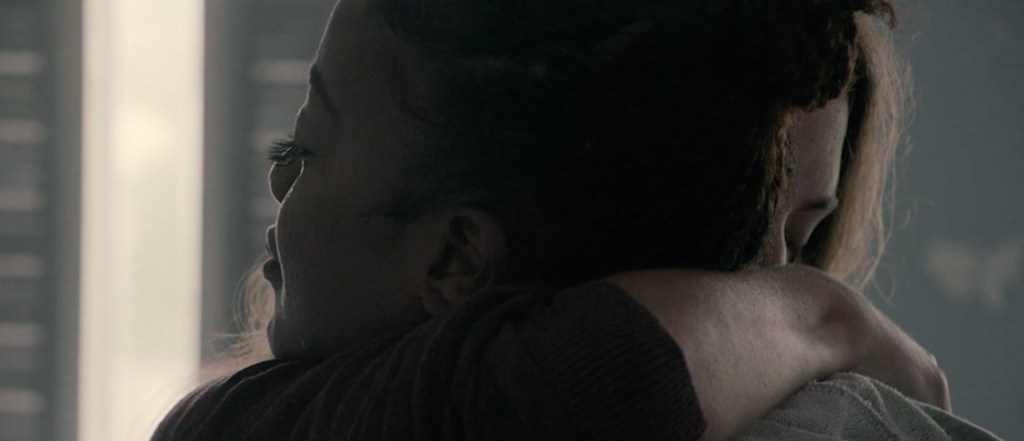
Holloway has now closed down, but in my nightmares I still awake within its 18 feet high impenetrable walls. I was 20 years-old when I was sentenced to a four year prison sentence after I’d become involved in a non-violent protest campaign to close down an animal testing laboratory as a teenager. Like the suffragettes and Greenham Common protesters who were also held in HMP Holloway, I knew my activism could one day land me behind bars. However prison was nothing like I had imagined it would be. In 1906, a suffragette described Holloway as “the women’s university,” a place from which you graduate with a new understanding of the world and the forces that shape it. A century later, it remained just that.
Many people are taking away from the Holloway documentary the contributor’s shared experiences with childhood trauma, however one thing that feels important to me to highlight is the trauma that is inflicted within and by this so-called “justice” system. Violence in the home is a horrible thing for anyone, child or adult to have to endure. But when that violence comes from the state, it carries a different, more insidious weight: because it wears the disorienting mask of legitimacy, repackaging harm as help and telling us that violence done to us can be necessary, even healing.
I am so proud of the other women who appear in this film: they are fierce and inspiring changemakers doing immense good within our community. Yet, if I’m honest, I struggle to stand beside them with the same sense of pride. I left prison not emboldened, but broken. I live in terror of speaking up, of protesting, of posting on social media, scared that any act of defiance might once again put a target on my back and cost me years of my life. I remain an activist, but every day is a struggle, and I fear I am a shell of the person I once was.
The suffragettes understood that disruption was necessary. To win the right to vote, the suffragettes engaged in a militant direct action campaign under the slogan “’Better broken windows than broken promises’”. They resorted to criminal damage, targeted key infrastructure and even used improvised explosive devices and arson in order to push through their demands against a government that saw them as less-than. It is noteworthy than while many of them found themselves locked up in HMP Holloway, the maximum sentence served was just three months.
Compare this to today. Under the Police, Crime, Sentencing and Courts Act 2022, anyone who is involved in a protest that causes another person to merely feel annoyed can face up to ten years in prison for having caused a “public nuisance”. Just Stop Oil activists have been sentenced to five year prison sentences for planning an entirely peaceful protest. 18 Palestine Actionists are right now locked in prison and treated as terrorists for sabotaging weapons that had been destined to tear through the bodies of men, women and children in Gaza.
It is both maddening and heartbreaking to see how people who are trying to prevent climate collapse or a genocide can be so heavily criminalised by our legal system, and punished with cripplingly long prison sentences, while the arms dealers and oil executives of this world walk free. There are no calls for their rehabilitation, nobody insisting upon their moral re-education, nobody locking them inside a prison and insisting they come out reformed and redeemed.
Is it really only the poor, the racialised, the already broken, and the dissident who must be taught how to behave? And in this world that can livestream a genocide and do nothing, do words like “justice” and “law” even have meaning anymore?
And where does all this criminalisation leave us? If Martin Luther King had been sentenced to years in prison rather than days, would the civil rights movement have prevailed? Would women have the right to vote, if the leaders of the suffrage movement had not been released after a few months and been allowed to go back to campaigning, but had instead been subjected to gruelling probation restrictions banning them from political organising? If it hadn’t been for queer people battling for social change through protests, rallies and riots, would the LGBTQ community today be allowed to simply love who we love?
The answer to that question terrifies me. Because in amongst all the claims of social progress, what kind of progress is it, when good, kind, caring people are locked away in prisons, out of sight, out of mind? Activist or not, today’s criminal system doesn’t just punish. It erases people from public view and political relevance. Not because they are beyond help, but because it is easier to punish them than to care for them. Easier to disappear people behind prison walls and razor wire fences than to address the violence that shapes all of our lives. Easier to pathologise the survival of women than to reckon with the systems that made survival necessary in the first place. What does it say about our society that we treat wounded people as disposable, and call that justice?
While every successive politician promises to be even tougher on crime, promising ever more police and prison cells, they systematically defund the very things that actually prevent it. Prisons aren’t a solution, but a brutal diversion. Not a sticking plaster, but a tourniquet clamped around the wrong limb, cutting off life to the very systems that our communities need to heal. The safest neighbourhoods are not the ones teeming with police or walled in by prisons. They’re the ones where people have what they need to survive and thrive: stable housing, healthcare, education, support, and dignity.
And isn’t that what we should all be fighting for? Not more cells and sirens, but a world where every life is valued, no one is abandoned to violence, and where no one is disposable?
We don’t break cycles of harm by disappearing the people most failed by society. We break them by dismantling the conditions that produce suffering in the first place: poverty, injustice, and inequality.
Because our world doesn’t need more cages. It needs more care, more safety, and more hope. It needs courage. It needs compassion. It needs us.
So the real question is not whether we can afford to reimagine this system: it’s whether we can afford not to.